How to Identify Backyard Birds Step by Step
This article may contain affiliate links. If you make a purchase through these links, we may earn a small commission at no extra cost to you. This helps us keep creating free content.

Cornell Lab's Bird Academy teaches a four-part identification method, size and shape, color pattern, behavior, and habitat, and that same sequence, applied in order, resolves the large majority of backyard bird sightings without ever needing a full field guide flip-through. The order matters: starting with color, which is most beginners' instinct, is actually the least reliable starting point, since lighting and angle change how a color appears far more than they change a bird's size or shape.
Step 1: Size and shape
Compare the bird to a familiar reference species, sparrow-sized, robin-sized, or crow-sized are the three most useful benchmarks, since nearly everyone has a mental size reference for all three. Then note the overall shape: chunky and round (like a finch), slim and long-tailed (like a mockingbird), or upright with a thin bill (like a wren).
| Reference size | Common backyard examples |
|---|---|
| Sparrow-sized (5-6 in) | Chickadees, wrens, warblers, most sparrows |
| Robin-sized (9-10 in) | Robins, cardinals, blue jays, mockingbirds |
| Crow-sized (17-20 in) | Crows, mourning doves are smaller, most hawks larger |
Step 2: Color pattern, not just color
The most useful color information isn't overall color but the pattern, where color blocks meet, not just what colors are present. A bird with a solid gray back and a rusty-red belly (Eastern towhee, American robin) is identified by the pattern of that contrast, not by "it was reddish," which could describe a dozen unrelated species depending on lighting.
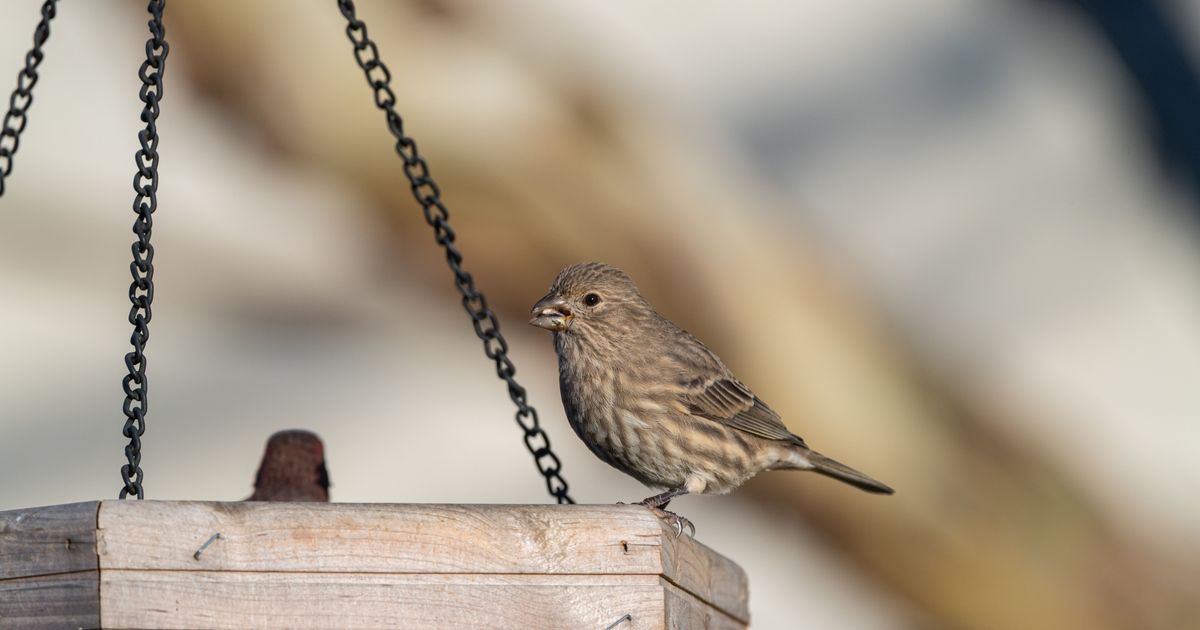
- Note the head pattern first, eye-rings, eyebrow stripes, and crown color are among the most diagnostic single features in the entire body.
- Check wing bars, pale stripes across the folded wing, since their presence or absence separates many otherwise similar species.
- Look at the breast: solid, streaked, or spotted are three very different signals (a spotted breast points strongly toward a thrush, for example).
Step 3: Behavior
Behavior is consistent within a species and often visible well before plumage details are, making it one of the fastest shortcuts to a correct family-level identification.
- Woodpeckers climb tree trunks in short hops, bracing with a stiff tail.
- Nuthatches famously climb head-first down a trunk, the only common backyard bird that does so.
- Mockingbirds and catbirds often hold the tail cocked upward and flick it repeatedly while perched.
- Chickadees and titmice move in small, active, often mixed flocks and hang upside-down from branch tips while foraging.
- Doves feed almost entirely on the ground and walk rather than hop.

Step 4: Habitat and location
Where in the yard a bird is seen, ground, shrub layer, feeder, or high canopy, combined with the region and season, eliminates entire categories of species instantly. A bird foraging on open lawn is a completely different candidate list than one gleaning insects from high leaves, even if their rough size is similar.
Six backyard birds to know cold
Learning these six species thoroughly gives most U.S. backyard birders a working baseline that every unfamiliar bird can be compared against:
- Northern cardinal: Unmistakable bright red male with a crest and thick, cone-shaped bill; females are buffy-brown with red-tinged wings and tail.
- American robin: Gray-brown back, brick-red breast, yellow bill; forages on lawns with a distinctive run-stop-tilt pattern while listening for worms.
- Black-capped chickadee: Black cap and bib with white cheeks; constant, active movement and a clear "chick-a-dee-dee" call.
- Blue jay: Bright blue above, white below, with a prominent crest and a loud, harsh call; often the loudest, most conspicuous bird at a feeder.
- Mourning dove: Soft gray-brown, plump body, small head, pointed tail; a mournful, hooting call and a whistling wing sound on takeoff.
- House finch: Males show a red wash across the head and breast that varies in intensity; females are streaky brown, easily confused with sparrows until the streaking pattern is learned.
Putting the steps together
Applied in sequence, this method turns "I don't know what that was" into a short, specific list of candidates within seconds: sparrow-sized, streaked breast, ground-feeding, in a brushy yard already narrows the field dramatically before color is even fully considered. The four-step order isn't arbitrary, it moves from the traits least affected by lighting and viewing angle to the traits most affected by them, which is exactly why it consistently outperforms a color-first approach.

Sound as a fifth, often faster signal
While the Cornell four-part method focuses on visual traits, a call or song heard alongside a visual sighting often confirms an identification faster than any single visual field mark. A blue jay's harsh call, a mourning dove's soft hooting, and a chickadee's namesake "chick-a-dee-dee" call are all recognizable within a single hearing and pair naturally with the visual method rather than replacing it, using both together resolves backyard sightings faster than either alone.
Common backyard bird confusion pairs
| Often confused | Key difference |
|---|---|
| House finch vs. purple finch | House finch has brown-streaked flanks; purple finch is more uniformly raspberry-washed |
| Downy vs. hairy woodpecker | Downy is smaller with a proportionally shorter, stubbier bill |
| House sparrow vs. song sparrow | House sparrow has a plain gray breast; song sparrow shows heavy streaking with a central spot |
| Cooper's hawk vs. sharp-shinned hawk | Cooper's is larger with a proportionally bigger head and rounder tail tip |
Age and sex differences within a single species
Many backyard species look notably different between males, females, and juveniles, which can make a single species seem like three different birds to a beginner. Northern cardinals are the clearest example: bright red males, buffy-brown females, and juveniles that resemble females but show a dark, not orange-red, bill until their first full molt. Recognizing that plumage variation exists within a species, not just between species, prevents a common source of beginner over-counting, where a female and juvenile of the same species get logged as two different, unidentified birds.
Using range and season as a final check
After working through size/shape, color pattern, behavior, and habitat, a final check against range maps and seasonal timing catches remaining errors, a species that looks right on every other trait but doesn't occur in a given region or season is far more likely a look-alike than a genuine rarity. Field guide apps with built-in range maps make this check nearly instant and are worth consulting even after a confident identification, simply as a final sanity check.
Keeping a simple yard list
Applying the four-step method consistently and logging results, even informally, turns backyard birding into a running project rather than a series of disconnected sightings. A basic yard list, species, first-seen date, and a rough seasonal pattern, often reveals within a single year that a "boring" yard hosts more species than expected, since many pass through briefly during migration without ever visiting a feeder.
When a bird still won't resolve
Not every backyard sighting resolves cleanly even after working through all four steps carefully, and that's a normal, expected outcome rather than a failure of the method. Logging it as "unidentified, [brief description]" and moving on, rather than forcing an uncertain guess into a confident-sounding label, keeps a personal record more honest and often gets resolved later when the same bird, or a clearer view of the same species, turns up again.
Published by the Birdwatching Advice editorial team. Published March 22, 2026. Updated September 12, 2026.
Editorial responsibility: see Imprint.
Spotted an error or have something to add? corrections@birdwatchingadvice.com
Spot More Birds
Weekly birding tips, migration alerts, and identification guides straight to your inbox.
🎁 Free bonus: Backyard Birding Checklist (PDF)
You might also like

Explore more
All articles on Birdwatching Advice →